
Low vs high porosity hair: the difference
They look similar on a bad hair day but need opposite routines. Here is how low and high porosity hair differ, and how to tell which one is yours.
The core difference
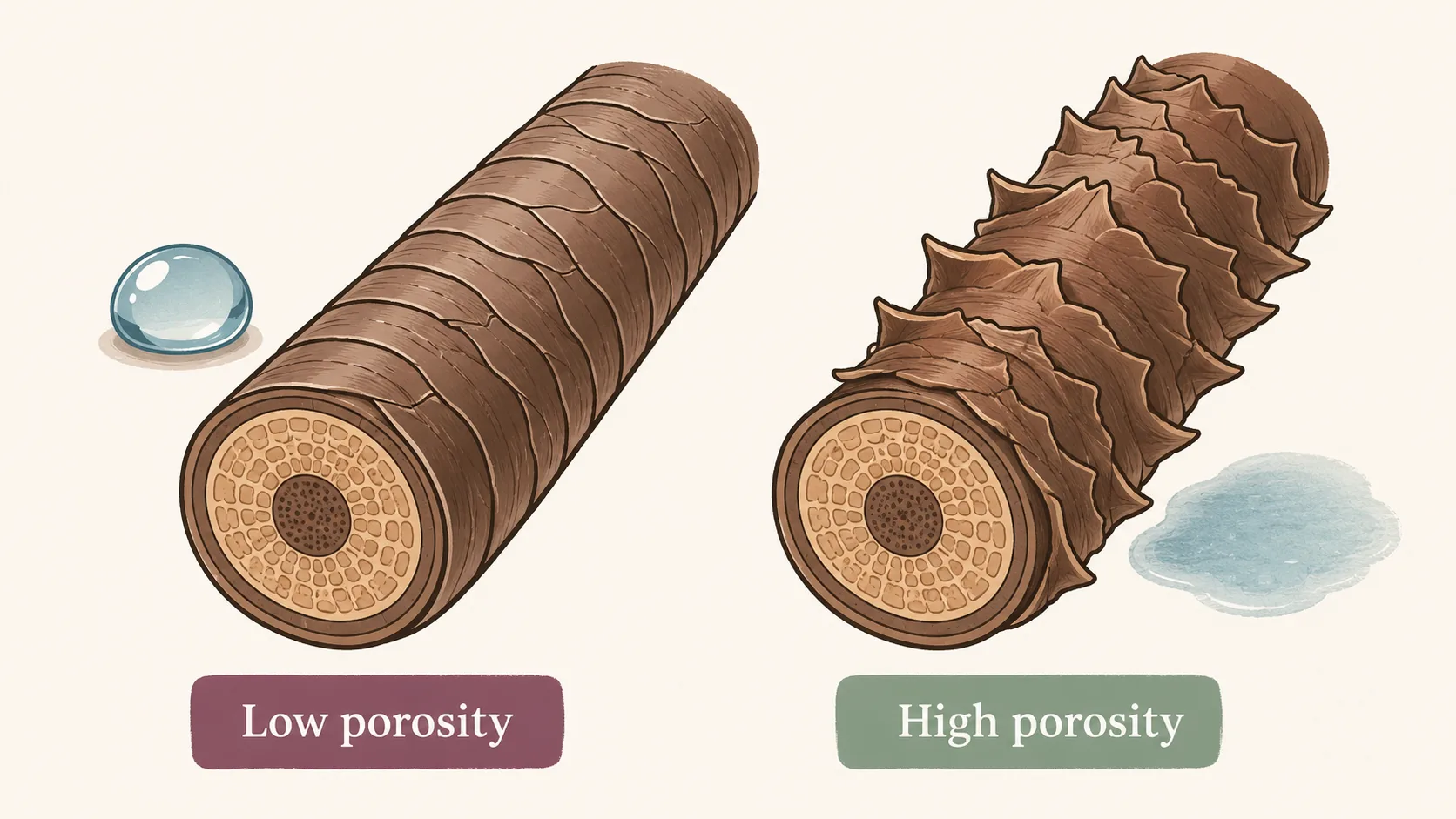
Porosity sounds technical, but it comes down to one simple thing: how open the outer layer of your hair is. Every strand is wrapped in a cuticle made of tiny overlapping scales, a bit like roof shingles. How tightly those scales lie flat decides how easily water and product move in and out of your hair. That is porosity, and it is the single biggest reason two people can use the same products and get opposite results.
Low porosity hair has a tight, flat cuticle. The scales lie close together, so they resist letting moisture in. The upside is that once water does get in, it stays. The downside is that products tend to sit on the surface and pile up rather than sinking down.
High porosity hair has a raised, gappy cuticle. The scales lift away from the strand, leaving openings that let moisture rush in quickly and then escape just as fast. That is why high porosity hair can feel hydrated one minute and dry the next.
Medium porosity sits between the two, with a cuticle that is open enough to take in moisture but closed enough to hold it. It is the balanced, easygoing middle, and it is what most routines are quietly aiming for.
Side-by-side comparison
Here is how the two types stack up across the things you actually notice day to day.
| Low porosity | High porosity | |
|---|---|---|
| Cuticle | Flat and tight | Raised and open |
| Water behavior | Beads and resists | Soaks in fast |
| Dry time | Slow, stays damp | Dries very fast |
| Products | Sit on top, build up | Absorb fast, wash out fast |
| Frizz | Less prone | Very prone |
| Common causes | Usually genetic | Often damage, color, heat |
| Best products | Lightweight, water-based, humectants | Protein, rich creams, sealing oils |
| Protein | Use sparingly | Usually needs it |
How to tell which you are
You do not need a lab. A few quick observations at home will point you in the right direction, and stacking them together gives a far more reliable answer than any single test.
- The float test. Drop a clean, dry strand into a glass of water and wait a few minutes. If it keeps floating, that points to low porosity. If it sinks, that points to high porosity. Make sure the hair is free of product first, since residue can throw off the result.
- The spray test. Mist a section of dry hair with water and watch closely. On low porosity hair the droplets bead up and sit on the surface. On high porosity hair they vanish almost instantly as the strand drinks them in.
- Dry time. Notice how long your hair takes to air dry after washing. Hair that stays damp for hours leans low porosity. Hair that is dry surprisingly fast leans high porosity.
- The quiz. The on-site test weighs several of these signs at once instead of relying on a single clue, which is why it tends to give a more dependable read than any one test on its own.
One test can mislead you
Product buildup, hard water, and even how you collected the strand can all skew a single test. If two methods disagree, trust the pattern across several signs rather than the odd one out, and take the quiz to settle it.
Can you be in between
Yes, and it is common. Medium porosity, sometimes called normal porosity, is a real category and it is the one most people are trying to reach. Its cuticle is open enough to absorb moisture without a fight, yet closed enough to keep it, so hair holds a style, takes color evenly, and bounces back after washing.
Porosity is not always uniform along a single strand, either. Your roots are the newest, least weathered part of your hair, so they often read lower in porosity. The ends are older and have lived through more washing, brushing, sun, and styling, so they tend to read higher, especially if your hair is colored or heat-styled. That is why one head of hair can genuinely be low at the scalp and high at the tips, and why your ends usually need a little more care than your roots.
What each one needs
Once you know your type, the routine almost writes itself, because each one is solving the opposite problem.
Low porosity hair needs help getting moisture past that tight cuticle, then needs to avoid heavy products that pile up on the surface. Think lightweight, water-based leave-ins, humectants that draw water in, and a little gentle warmth (like a warm towel or steam) to coax the cuticle open. Go easy on heavy butters, oils, and protein, which tend to sit on top. The full walkthrough lives in our low porosity hair guide.
High porosity hair needs to fill the gaps in that raised cuticle and then lock the moisture in before it escapes. That means richer creams, regular conditioning, protein to help reinforce the strand, and sealing oils or butters layered on top to slow water loss. The complete routine is in our high porosity hair guide.
Low vs high porosity, answered
Is low or high porosity hair better?
Neither is better. Medium porosity is the easiest to care for, but low and high porosity hair can both be healthy. What matters is matching your routine to your cuticle.
How do I tell if I am low or high porosity?
Use the float test (floats = low, sinks = high), notice your dry time (slow = low, fast = high), and take the quiz, which weighs several signs at once for a more reliable read.
Can I have both low and high porosity hair?
Yes. Porosity often varies along the strand. Roots can be lower porosity while ends, which are older and more weathered, read higher, especially when colored or heat-damaged.